
A plaintiff-specific accrual rule expands the potential timing of some agency challenges without eliminating finality, exhaustion, special review deadlines, or remedial limits.
A regulation’s age no longer provides the complete answer to whether a new plaintiff can challenge it under the federal Administrative Procedure Act. The more useful intake question is when this plaintiff first had a complete claim. Even then, timeliness is only one part of the analysis. A timely lawsuit can still fail because the challenged action is not reviewable, the wrong forum was selected, or the requested remedy lacks a sufficient legal basis.
Identify the statute that supplies the deadline
28 U.S.C. § 2401(a) generally requires covered civil actions against the United States to be filed within six years after the right of action first accrues. Begin by checking whether a more specific statute supplies a different deadline, review mechanism, or court. The six-year provision should not become a default calendar entry before counsel has identified the governing regulatory program.
In Corner Post, Inc. v. Board of Governors (2024), the Supreme Court held that an APA claim governed by § 2401(a) accrues when the plaintiff is injured by final agency action. Corner Post began operating after the challenged interchange-fee regulation had already existed for years. The Court rejected an accrual rule tied solely to the rule’s publication. Its holding concerns this limitations provision; the opinion recognizes that more specific timing statutes can displace it.
Build a chronology around the plaintiff
The litigation file should distinguish at least three events: completion of the relevant agency decision, the plaintiff’s first legally cognizable injury, and filing. Assemble contracts, transaction records, licensing communications, and other contemporaneous materials that help establish the asserted injury date. Incorporation or entry into a market may be relevant, but a lawyer should explain why a particular event produced injury rather than simply reciting a company’s formation date.
Hypothetical: A federal rule becomes final in 2014. A retailer begins operations in 2023 and first incurs a challenged regulatory burden that year. If § 2401(a) governs and the retailer first acquires a complete APA claim in 2023, the rule’s 2014 publication does not alone make a 2026 suit untimely. A sector-specific deadline or a different injury chronology could change the analysis. Repeated costs should not be assumed to restart an already accrued claim.
Finality and exhaustion need their own analysis
APA § 704 addresses actions made reviewable by statute and final agency action for which there is no other adequate judicial remedy. Its treatment of preliminary decisions and further administrative review is distinct from the limitations clock. Counsel should identify the particular action being challenged, the stage reached by the agency, and the legal effects of its decision. A new injury does not automatically turn a tentative agency position into a reviewable final action.
Darby v. Cisneros (1993) limits judicial creation of additional exhaustion requirements in APA cases. Under § 704, an appeal to superior agency authority is a prerequisite when expressly required by statute or when an agency rule requires it and makes the action inoperative pending that appeal. That principle does not justify ignoring a governing statute’s review scheme. It also should not be confused with rules requiring particular issues or objections to have been presented to the agency.
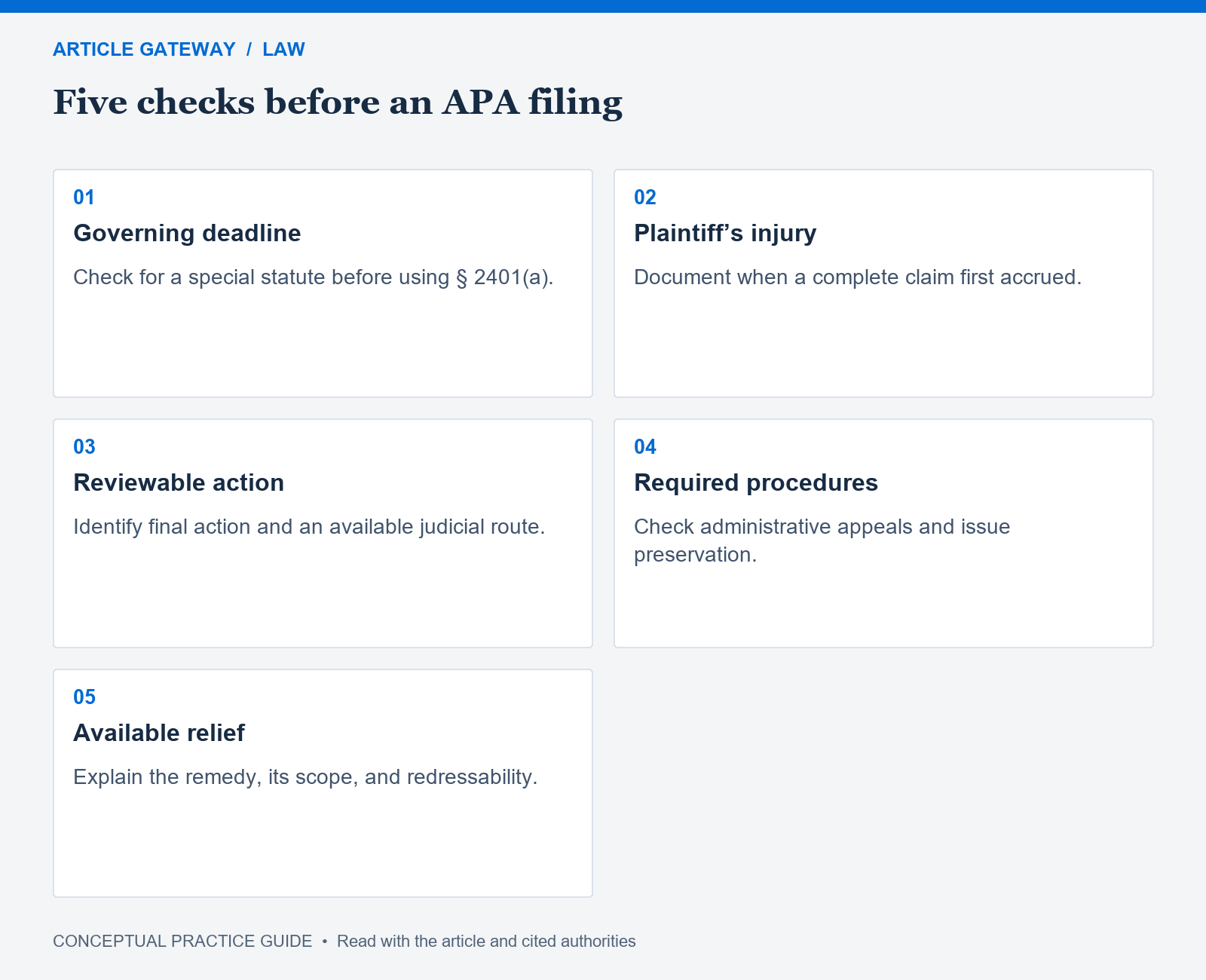
A useful review memorandum treats accrual, finality, administrative appeals, issue preservation, and judicial forum as separate questions. Writing a short answer for each helps prevent the assumption that one favorable timing decision supplies the entire path into court.
Design the remedy before promising the result
A timely challenge does not itself establish a right to nationwide relief. In Trump v. CASA, Inc. (2025), the Supreme Court addressed the equitable authority for universal injunctions and expressly reserved the distinct question of APA vacatur. Counsel therefore should distinguish an injunction against enforcement from an order setting aside agency action. The availability, scope, and procedural basis of relief require analysis of the claim, governing precedent, and proposed order.
The requested disposition should explain what the court would direct, who would be bound, and how that direction would redress the plaintiff’s injury. Consider whether the alleged defect affects the entire rule or a separable provision. If immediate relief is necessary, develop the supporting evidence at the outset instead of assuming that a strong merits theory resolves the interim-relief inquiry.
At intake, the most useful product is a dated chronology accompanied by a short jurisdiction-and-remedy memorandum. Record uncertainties explicitly, including disputed injury dates and potentially applicable special deadlines. This gives the client a concrete basis for evaluating timing and litigation objectives without confusing access to review with success on the merits.
Jurisdiction note: These principles address federal APA litigation. State agency challenges have their own filing periods, exhaustion requirements, and remedial rules; federal circuits may also differ on issues the Supreme Court has not resolved.