
A delegation clause can assign arbitrability questions to an arbitrator, but conflicting agreements require an earlier inquiry into what the parties actually accepted.
A motion to compel arbitration often begins with a broad delegation clause: the parties agreed that an arbitrator would decide whether a dispute belongs in arbitration. That clause matters, but counsel should first establish which agreement governs. A transaction may involve account terms, purchase conditions, a later amendment, and a separate promotional contract. Reading only the document containing the strongest arbitration language can leave the decisive issue unanswered.
The question before the question
In Coinbase, Inc. v. Suski, 602 U.S. 143 (2024), users accepted an account agreement containing arbitration and delegation provisions, then sweepstakes rules selecting California courts. The Supreme Court held that a court must decide which contract controls that conflict. The decision identifies the decision-maker; it does not establish that every later forum clause automatically supersedes every earlier delegation.
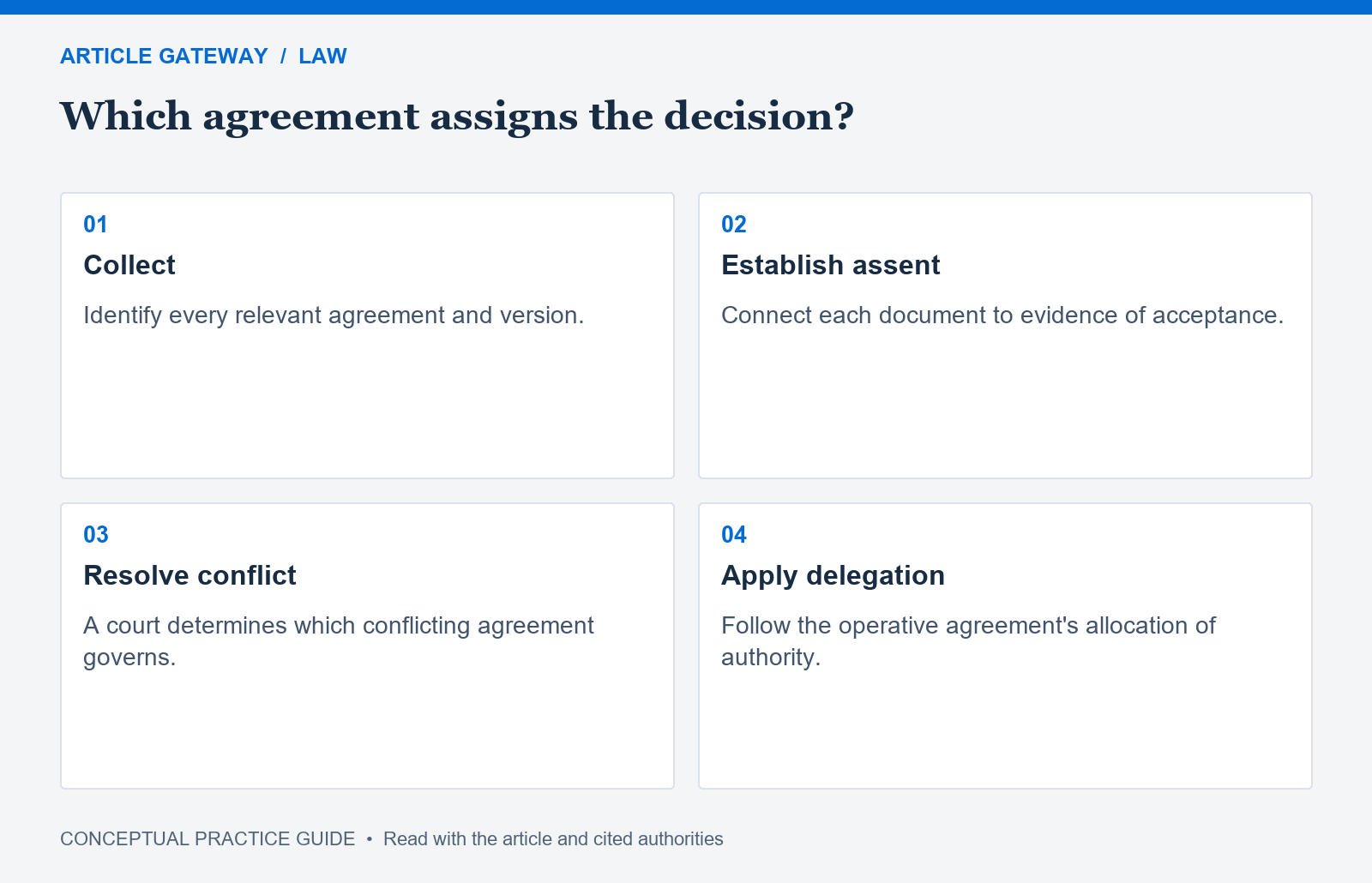
The practical implication is a sequence of inquiries. Identify the relevant agreements and the parties’ assent, determine whether their provisions conflict, and then address the authority assigned by the governing contract. Treating these as distinct questions makes a motion more precise and can narrow the evidence needed at the outset.
Delegation remains enforceable within its proper boundaries
Henry Schein, Inc. v. Archer & White Sales, Inc., 586 U.S. 63 (2019), supplies the complementary rule. When a valid agreement delegates arbitrability, a court cannot retain that issue merely because it thinks the argument for arbitration is wholly groundless. Delegation requires clear and unmistakable evidence. The Court did not decide whether the particular contract before it satisfied that requirement.
The two decisions therefore address different stages. Counsel invoking delegation should explain why the clause remains operative across the entire contractual relationship. Counsel opposing arbitration should identify the actual objection: no assent, displacement by another agreement, a challenge directed to the delegation provision, or a dispute about the reach of an otherwise operative clause. Simply calling every objection a formation issue does not determine who decides it.
For a drafter, that distinction suggests a useful discipline: describe both the disputes subject to arbitration and the treatment of disputes about the arbitration agreement. Then review every exception alongside that language. An injunction provision, for example, should communicate whether it permits temporary court relief while arbitration continues or allocates an entire category of merits disputes to court.
Build the record before arguing the clause
Section 2 of the Federal Arbitration Act generally makes covered written arbitration agreements enforceable, subject to generally applicable contract defenses and statutory exceptions. It does not eliminate the need to establish agreement. Under 9 U.S.C. § 4, a genuine issue about making the arbitration agreement can require a trial of that issue in federal court. The statute also requires an appropriate basis for federal jurisdiction; citing the FAA alone does not supply one.
A useful evidentiary file includes the exact version of each agreement, the date and method of acceptance, the screen or document presented to the user, and the relationship between the agreements. For electronic transactions, a current website screenshot may not establish what appeared months earlier. Version history, acceptance records, and testimony explaining the system can answer different parts of the proof problem.
The opposing party should be equally specific. A denial should address the relevant event or document rather than rely on the fact that the party does not presently remember reading it. The legal effect of notice and conduct depends on the governing law and the evidence; the goal is to identify the factual disagreement the court must resolve.
A hypothetical drafting problem
Hypothetical: A software subscription requires arbitration and delegates arbitrability. A later enterprise order says that courts in a named state have exclusive jurisdiction over disputes arising from that order. An implementation dispute follows. Before arguing that the delegation clause sends everything to arbitration, counsel should compare the order’s scope, amendment language, incorporation provisions, and precedence clause. A court may need to decide whether those documents preserve or displace the earlier allocation.
A drafting review can reduce this uncertainty by using one coordinated dispute-resolution scheme, expressly identifying surviving provisions, and explaining how later orders relate to the master agreement. A generic merger clause deserves particular attention where multiple documents are intended to remain operative.
State law and the limits of a national rule
State-law distinction: Contract formation, interpretation, modification, and supersession remain sensitive to the applicable state’s law, subject to federal arbitration requirements and preemption. Suski does not supply a universal rule for reconciling all contracts. Courts’ treatment of incorporated arbitral rules and particular exceptions also requires attention to controlling precedent. A reliable analysis connects the federal allocation rule to the actual state-law contract question, rather than assuming that broad wording alone resolves consent.