
Human authorship remains central to U.S. copyright. The practical task is to identify protectable contributions without treating registration as a clearance opinion.
A publisher asking whether an AI-assisted work can be copyrighted needs a more specific inventory: which expression did a person create, and which elements did the system determine? A manuscript, illustration, or presentation can contain several kinds of contribution. Assessing them separately produces a more defensible registration claim and a clearer explanation of what a license actually conveys.
That inquiry begins with 17 U.S.C. §§ 102 and 103. Copyright protects qualifying original expression fixed in a tangible medium, and protection for a compilation or derivative work reaches the author’s original contribution. Ideas and methods are outside copyright’s scope. Those principles help frame AI questions without treating the use of a particular tool as the entire legal analysis.
What Thaler decided
In Thaler v. Perlmutter, 130 F.4th 1039 (D.C. Cir. 2025), the D.C. Circuit upheld the rejection of a registration identifying an AI system as the sole author. The court interpreted the Copyright Act to require human authorship. Its analysis addressed the claim presented in that administrative record; it did not resolve every degree of human involvement in generative workflows. Thaler’s argument that his creation and use of the system made him the author was not preserved before the agency.
The Supreme Court docket in No. 25-449 records denial of certiorari on March 2, 2026. The denial left the appellate judgment in place; it was not a Supreme Court merits ruling defining all AI-assisted authorship.
For counsel, the administrative-record point is especially useful. Describe the actual human contribution accurately when seeking registration. A later litigation theory may not repair a record built around a materially different account of how the work was created.
The Copyright Office’s practical distinctions
The Copyright Office’s January 2025 Copyright and Artificial Intelligence, Part 2: Copyrightability distinguishes assistive uses, prompts, human expression incorporated into outputs, and creative modifications or arrangements. Its position is that using AI as a tool does not itself defeat copyright. Protection depends on sufficient human control over expressive elements.
The report concludes that, with generally available technology as assessed there, prompts alone ordinarily do not provide sufficient control over resulting expression. It also recognizes that human-authored material perceptible in an output, creative modifications, and original selection or arrangement may qualify. The report is the Office’s analysis and policy position, not a statute or a judicial holding settling every future tool.
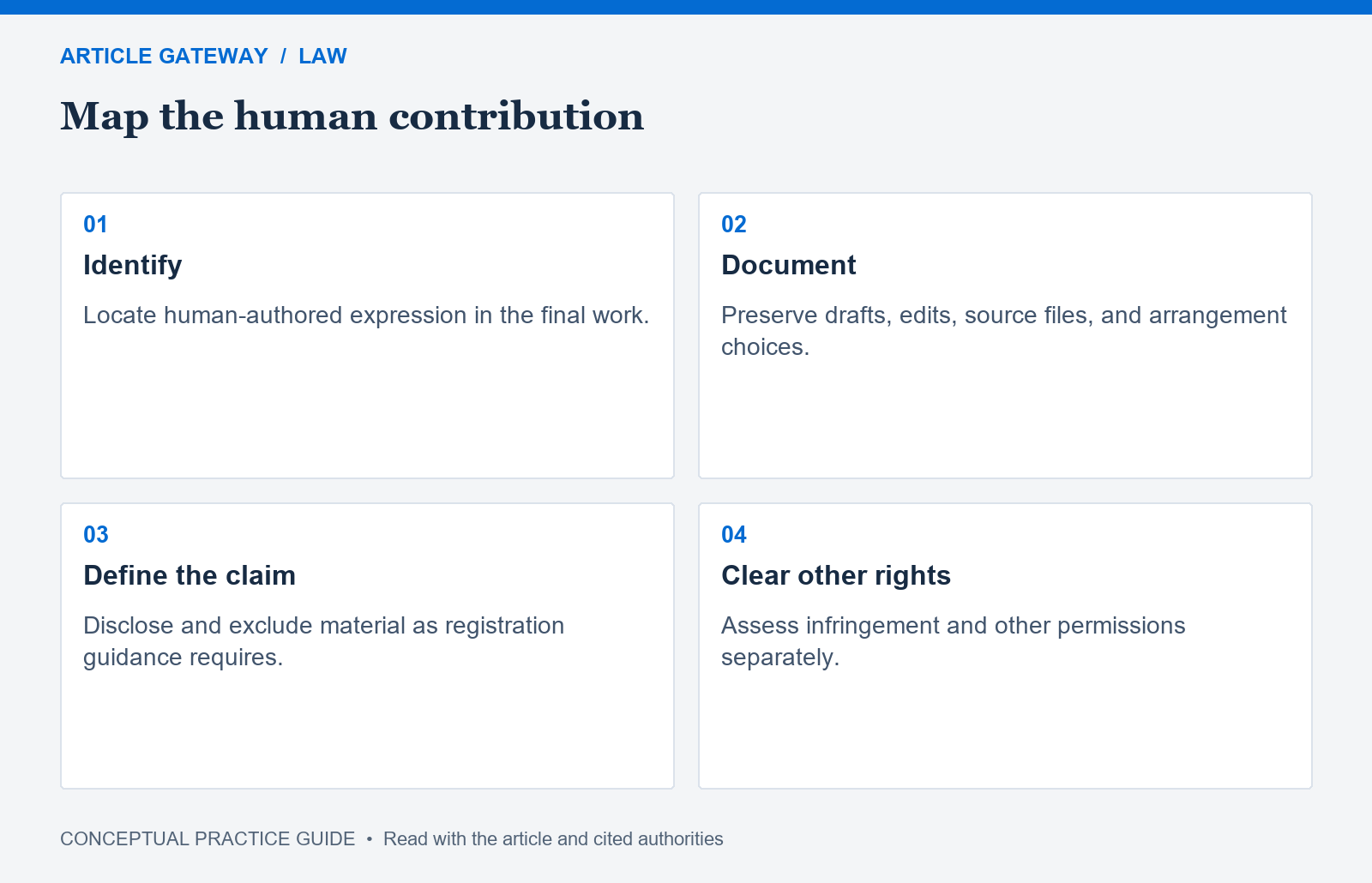
The resulting workflow should be evidentiary rather than numerical. A large number of prompts does not automatically establish authorship, while a short, original passage written by a person may be straightforward to identify. Save source files that make the creative process intelligible: human drafts, layered edits, original drawings, and decisions about arrangement. Keep generated material distinguishable where practical.
A hypothetical mixed work
Hypothetical: An editor writes an original essay, generates several background illustrations, redraws a central figure, and arranges text and images into a distinctive layout. Counsel should evaluate the essay, drawing changes, and arrangement on their own facts. The presence of human authorship in those elements does not automatically confer exclusive rights in every generated background.
That distinction should carry into contracts. An assignment can identify the creator’s human-authored contributions and disclose AI use. A license can explain the scope of claimed rights instead of promising exclusivity in every component. Supplier warranties should match the workflow the supplier actually used, and the review should account for third-party source material incorporated into that workflow.
Registration requires an accurate claim
The Office’s 2023 registration guidance instructs applicants to disclose AI-generated material and explain their human contributions; more than de minimis AI-generated content should be excluded from the claim. It also addresses correcting pending applications and existing registrations that omitted necessary information. Application language should therefore describe the authorship actually claimed, such as original text or qualifying selection and arrangement, rather than silently claiming the whole output.
A useful internal review pairs a copy of the finished work with an authorship map. Mark the claimed human expression, the generated components, any preexisting licensed material, and the records supporting each category. This is a practical organizing device, not an additional statutory registration requirement.
Copyrightability does not answer infringement
A work’s eligibility for protection is distinct from whether creating or distributing it infringes another person’s rights. A conclusion that generated material lacks its own copyright does not establish permission to reproduce protected source expression. Nor does a registration resolve whether training a model was lawful. Clearance, training-related claims, contractual restrictions, and authorship must be analyzed on their respective facts and legal standards.
State and circuit distinction: Federal copyright principles govern this article; Thaler is a D.C. Circuit decision. State contract and publicity claims can present separate questions, including federal preemption, and should not be assumed to share copyright’s authorship test. For each proposed use, separate the rights being claimed from the rights that may need clearance.
Primary sources
- Copyright Act, 17 U.S.C. chapter 1, including §§ 102 and 103
- Thaler v. Perlmutter, 130 F.4th 1039 (D.C. Cir. 2025)
- Supreme Court docket No. 25-449 — certiorari denied March 2, 2026
- U.S. Copyright Office, AI Report Part 2: Copyrightability (January 2025)
- Copyright Registration Guidance, 88 Fed. Reg. 16190 (March 16, 2023)