
An unchanged salary does not end a discriminatory-transfer claim. Counsel should identify the employment disadvantage, then separately prove discriminatory causation.
A transfer can preserve an employee’s title and salary while changing the substance of the job. The employee may lose responsibility, predictable hours, or access to work that develops professional skills. Evaluating such a claim requires a careful comparison of the position before and after the move, followed by a separate inquiry into why the employer acted.
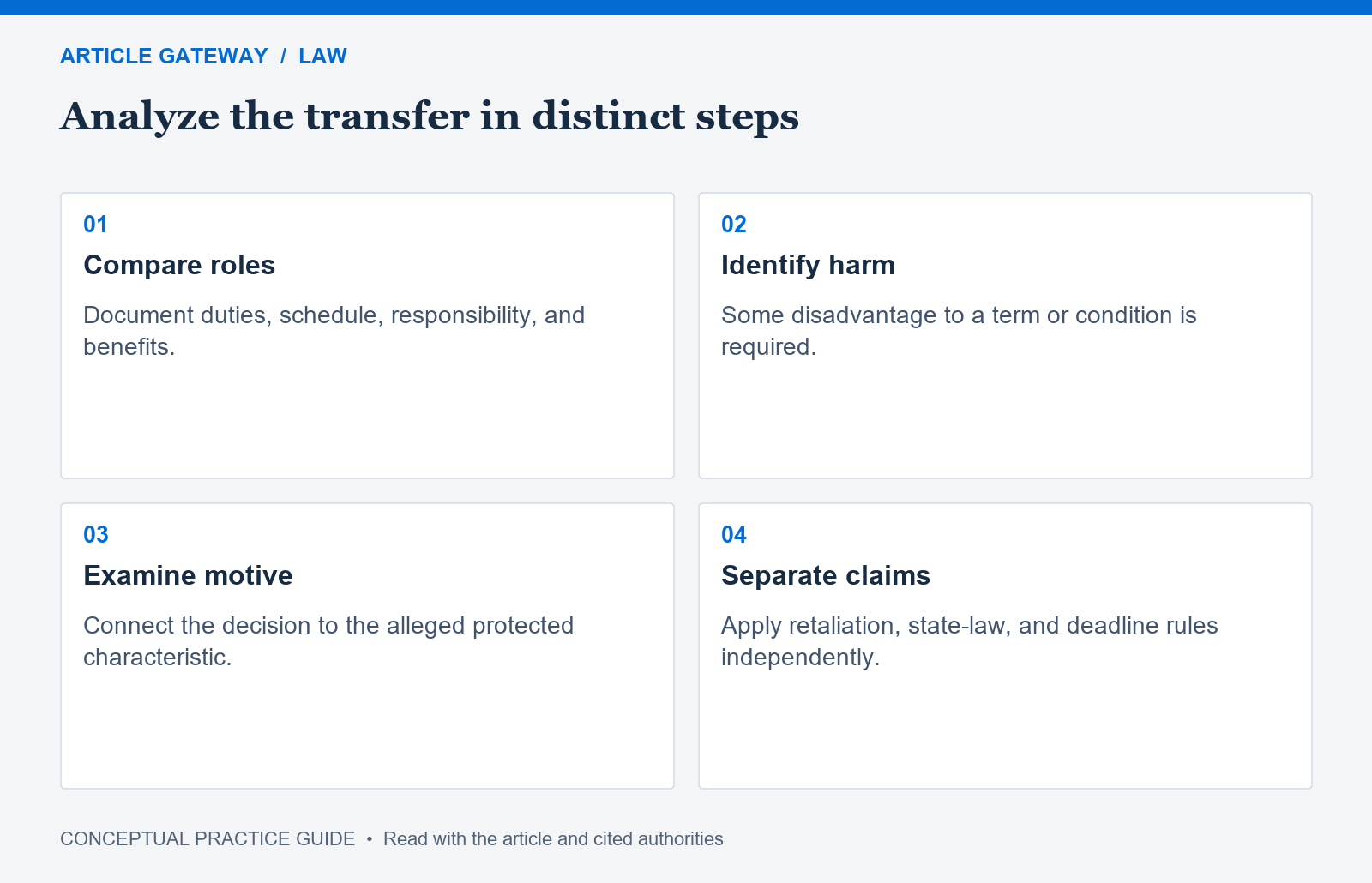
The federal harm standard
In Muldrow v. City of St. Louis, 601 U.S. 346 (2024), the Supreme Court held that an employee challenging a transfer under Title VII must show some harm to an identifiable term or condition of employment, but need not show significant harm. The plaintiff alleged changes in duties, schedule, and benefits despite retaining rank and pay. The Court vacated the judgment against her and remanded; it did not itself enter a liability verdict.
The statutory anchor is 42 U.S.C. § 2000e-2(a)(1), which addresses discrimination in compensation and employment terms, conditions, or privileges because of protected characteristics. The statute’s coverage is broader than compensation alone. A litigation assessment focused exclusively on lost wages can therefore miss a cognizable employment injury.
The practical response is specificity. Describe what changed, when it changed, and how the change disadvantaged the employee. A statement that the new assignment is less desirable gains force from evidence about actual duties, hours, workplace resources, and opportunities. An employer’s label of lateral transfer should begin the factual inquiry rather than conclude it.
Build separate records for harm and motive
For harm, compare job descriptions with how the work was actually performed. Calendars, assignment lists, schedules, access permissions, and contemporaneous messages may be more informative than a title. Interview people who observed the work before and after the transfer. Distinguish actual effects from predictions that have not occurred.
For motive, reconstruct the decision: who proposed the move, who approved it, what criteria were used, and which alternatives were considered. Identify the employer’s stated reasons and the evidence supporting or contradicting them. Comparable employees can be relevant, but comparisons should account for qualifications, responsibilities, decision-makers, and timing. Differences should be examined openly rather than hidden in a conclusory assertion that everyone was similarly situated.
A lower threshold for injury does not remove the need to connect the action to unlawful discrimination. An employee may establish disadvantage and still fail to prove discriminatory causation. Conversely, the absence of a salary reduction cannot substitute for examining an adequately supported claim about other employment conditions.
A hypothetical reassignment
Hypothetical: A project manager keeps the same salary but moves from client strategy work to routine administrative tracking. The new assignment includes weekend rotations and removes supervisory duties. Those facts provide concrete subjects for a harm analysis. If the employee alleges sex discrimination, the inquiry must also examine evidence that sex affected the decision.
The employer may have a documented operational explanation. Counsel should test that explanation against the chronology and actual implementation. Were several employees reassigned under the same criteria? Did the explanation change after a complaint? Were supposedly essential qualifications applied consistently? These are factual inquiries, not presumptions that a reassignment is either lawful or unlawful.
Retaliation remains a separate claim
Muldrow distinguished Title VII’s anti-retaliation provision and the Burlington Northern materially adverse standard. Retaliation asks whether the challenged conduct could dissuade a reasonable worker from making or supporting a discrimination charge; that inquiry can reach beyond workplace terms. Do not import the transfer holding’s harm standard into retaliation.
When both theories are pleaded, organize them separately. Identify the protected characteristic underlying the discrimination claim and the protected activity underlying retaliation. Then connect the evidence to each theory’s causation and injury requirements. One chronology can support both claims, but the legal elements remain different.
Ames removes a different extra hurdle
In Ames v. Ohio Department of Youth Services, 605 U.S. 303 (2025), the Supreme Court rejected a rule requiring majority-group plaintiffs to show additional background circumstances suggesting an unusual employer that discriminates against the majority. Title VII applies the same standard to individuals regardless of majority or minority status.
Ames did not relieve plaintiffs of proving discrimination or award judgment to the plaintiff on the merits. It also did not abolish the McDonnell Douglas framework: the majority assumed without deciding its application at summary judgment. Counsel should avoid turning either Ames or Muldrow into a broader proposition than the Court decided.
Preserve procedural and state-law distinctions
The EEOC’s filing guidance explains that charge deadlines generally run for 180 days, extended to 300 days where an appropriate state or local agency enforces a law covering the same basis. Federal employees generally follow a different process, starting with EEO-counselor contact within 45 days. Internal grievance proceedings ordinarily do not extend charge deadlines.
State-law distinction: State and local claims may differ in employer coverage, protected characteristics, remedies, and procedure. Analyze those claims under their own authorities rather than assuming that federal terminology settles them. Within the federal case, use current controlling circuit precedent for applying Muldrow to the specific action alleged, while keeping the Supreme Court’s rejection of a significant-harm threshold in view.