
Royal Canin makes the operative complaint central to supplemental jurisdiction. Counsel should reassess the forum whenever federal claims disappear.
A successful removal does not always secure a federal forum for the rest of the litigation. In Royal Canin U.S.A., Inc. v. Wullschleger, No. 23-677 (Jan. 15, 2025), the Supreme Court held that an amended complaint eliminating the federal claims that supported removal also eliminated supplemental jurisdiction over the remaining state claims. With no independent basis for federal jurisdiction, remand was required. For litigators, the practical consequence is to evaluate a proposed amendment as a possible forum decision as well as a pleading decision.
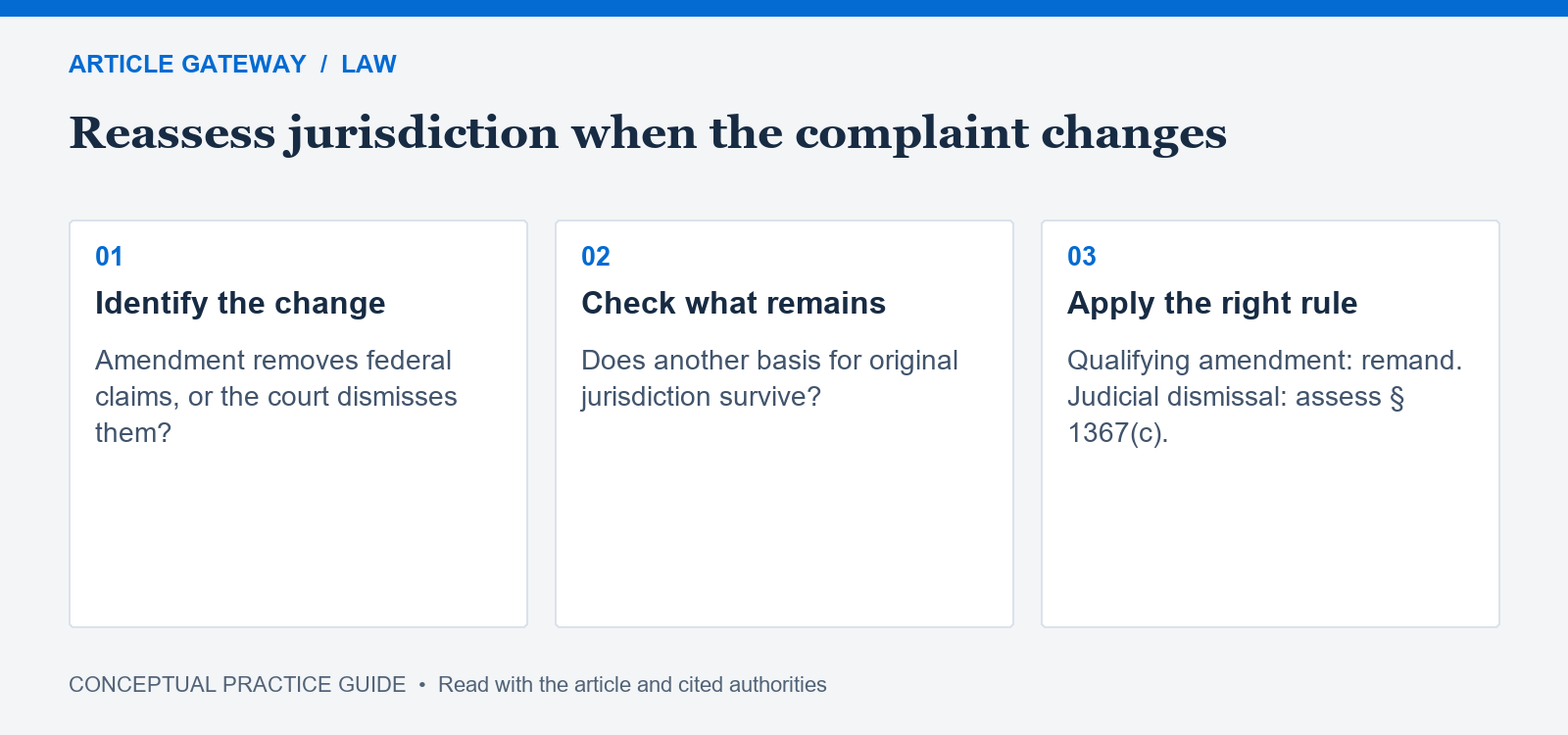
Read the operative complaint before defending the original removal
Federal-question jurisdiction initially supplied the foundation for removal in Royal Canin. Related state claims accompanied the federal issues through supplemental jurisdiction. After removal, the plaintiffs amended their complaint to remove the federal allegations. The Court concluded that the jurisdictional analysis had to follow the new pleading.
The statutory structure matters. 28 U.S.C. § 1367(a) supplies jurisdiction over qualifying claims related to an action within the district court’s original jurisdiction. It does not create a freestanding federal forum for state claims once the amended complaint removes the federal foundation. Arguments about judicial economy cannot supply a missing grant of jurisdiction.
A removal response therefore should identify what still supports federal adjudication. Pointing only to the original complaint leaves the central question unanswered. Conversely, a plaintiff seeking remand should explain precisely what changed and why the remaining claims lack an independent jurisdictional basis.
Distinguish amendment from a judicial dismissal
Deleting claims by amendment differs from losing federal claims on a motion. Section 1367(c)(3) expressly permits a court to decline supplemental jurisdiction after it has dismissed all claims within its original jurisdiction. That provision contemplates discretion. Royal Canin explains that an amendment excising the federal claims presents a different issue: supplemental jurisdiction itself disappears in the circumstances the Court addressed.
This distinction changes the briefing. After judicial dismissal, counsel may need to address whether the court should retain the remaining claims. After a qualifying amendment, counsel should first address whether the court has power to do so. The procedural record must make clear which event occurred; a stipulation, amended pleading, and dismissal order are not interchangeable documents.
Check whether another jurisdictional basis survives
The decision does not mean that removing a federal count automatically defeats every possible basis for federal jurisdiction. Diversity jurisdiction, for example, calls for its own analysis. Counsel should examine citizenship, amount in controversy, applicable removal restrictions, and the actual remaining parties. Special jurisdictional statutes may also matter.
Nor does relabeling a claim necessarily remove a federal question. The opinion recognizes that some state-law claims necessarily raise a substantial, disputed federal issue. Counsel must inspect the elements and allegations that remain, rather than count the number of headings labeled “federal.” The Court accepted the original federal-question determination in Royal Canin; it did not hold that every state claim mentioning a federal statute is removable.
Amendment requires its own procedural analysis
Federal Rule of Civil Procedure 15(a) specifies when a party may amend once as a matter of course and when written consent or leave of court is necessary. After a scheduling deadline, Rule 16 may add a separate good-cause inquiry. Royal Canin is not permission to disregard those requirements.
Before proposing amendment, counsel should identify the claims and remedies the client would surrender, check limitations and preclusion issues, and explain how the remaining case would proceed in state court. A procedural advantage can be costly if it removes a valuable substantive theory. A defendant opposing amendment should ground the opposition in applicable amendment standards and the record, rather than assume that removal freezes the complaint permanently.
A hypothetical case-management problem
Suppose an employee files a state-court action asserting one federal employment claim and related state claims. The employer properly removes. The parties are not diverse. The employee then validly amends the complaint to omit the federal claim, leaving only state theories that present no substantial federal issue. Under Royal Canin, the defendant cannot preserve supplemental jurisdiction merely by showing that federal discovery has begun.
Change one fact: the judge dismisses the federal claim, and the pleading is not replaced through amendment. Section 1367(c)(3) now supplies a different analytical route. The same practical wish to remain in federal court requires different legal reasoning.
Build a short jurisdiction review into each amendment
For each amended complaint, prepare a brief internal record identifying the operative pleading, every possible original-jurisdiction basis, the treatment of related state claims, and the next required filing. Section 1447(c) distinguishes procedural remand objections, generally subject to a 30-day motion deadline, from a lack of subject-matter jurisdiction identified before final judgment. A filing calendar should reflect that distinction without treating delay as a litigation strategy.
Once remand occurs, review the state court’s deadlines and procedures promptly. The substantive state claims survive or fail under their governing law; a change of forum does not decide their merits.
Primary sources
- Royal Canin U.S.A., Inc. v. Wullschleger, No. 23-677 (U.S. Jan. 15, 2025), especially pp. 6–10 and 19–20
- 28 U.S.C. § 1367, supplemental jurisdiction (official 2024 edition)
- 28 U.S.C. § 1447, procedure after removal (official 2024 edition)
- Federal Rules of Civil Procedure, Rules 15 and 16 (effective Dec. 1, 2025)