
The 2023 amendment puts the burden and the limits of each opinion at the center of federal expert-admissibility practice.
A respected expert uses a familiar method and delivers a confident conclusion. That combination can still leave a federal admissibility record incomplete. Counsel must connect the witness’s qualifications, the supporting facts, the method, and the particular opinion being offered. A lengthy curriculum vitae cannot supply a missing analytical step.
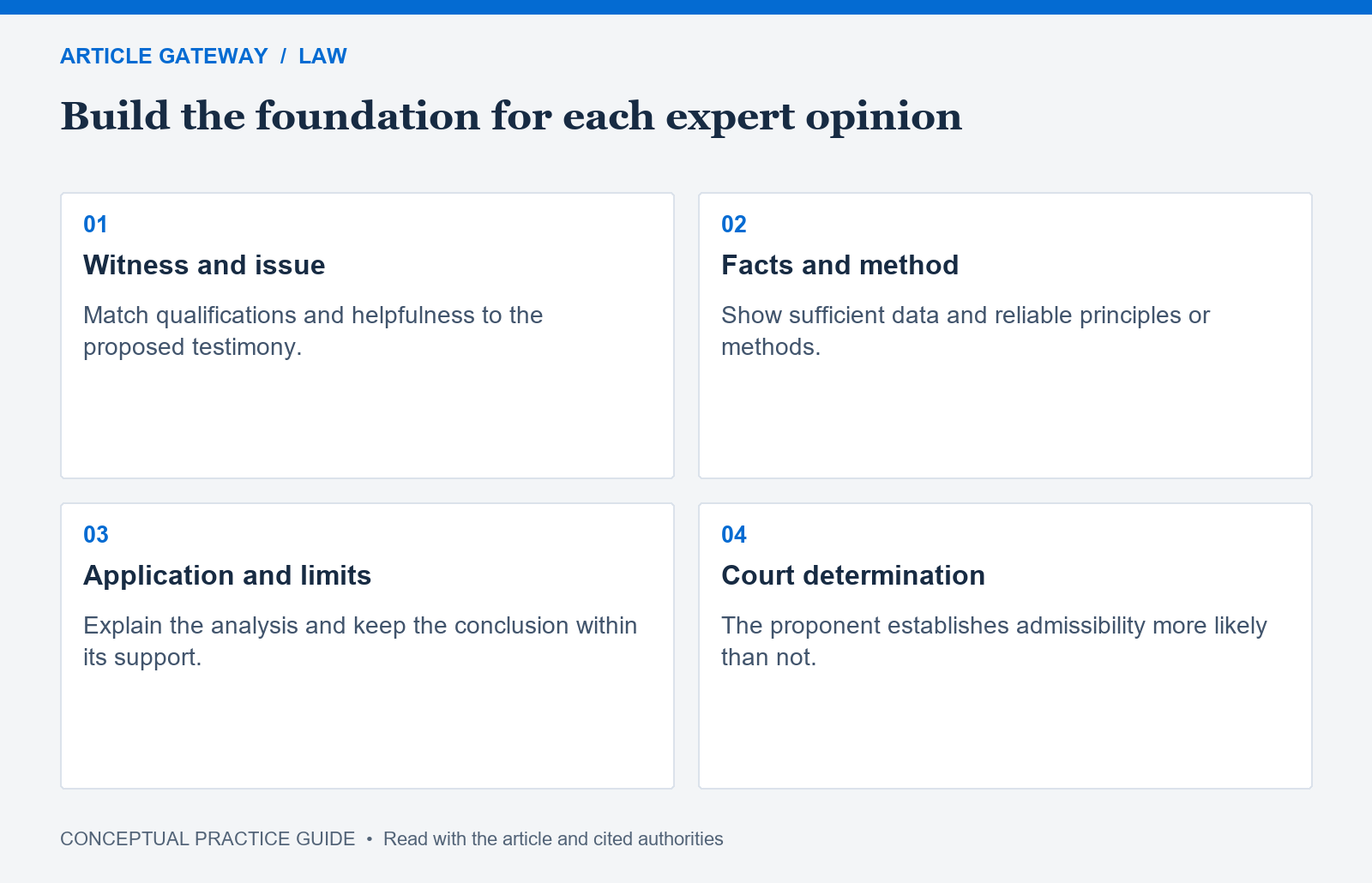
The amendment to Federal Rule of Evidence 702, effective December 1, 2023, makes two points explicit: the proponent must demonstrate the admissibility requirements to the court under a more-likely-than-not standard, and each opinion must reflect a reliable application of the principles and methods to the case’s facts.
Identify what the proponent must establish
The witness must be qualified through knowledge, skill, experience, training, or education. The proposed testimony must help the factfinder, rest on sufficient facts or data, result from reliable principles and methods, and reflect reliable application to the facts. Counsel should identify the evidence supporting each component rather than treating qualification as a proxy for the entire inquiry.
The 2023 advisory committee note characterizes the burden language as a clarification and emphasis of Rule 104(a)’s existing standard. It does not require the proponent to prove that the expert’s conclusion is ultimately correct. Reliability for admissibility and the merits of the case remain distinct questions.
That distinction also prevents misuse of the phrase “more likely than not.” It describes the judge’s determination of the rule’s admissibility requirements. It is not a universal instruction that every scientific conclusion must be expressed with a numerical probability greater than fifty percent.
Explain why a challenge concerns admissibility
The committee note rejects the categorical proposition that challenges to an expert’s factual basis or application of methodology always concern weight for the jury. A court must first determine whether the relevant admissibility requirement has been met. Once a sufficient foundation is established, some remaining objections properly affect weight.
For a proponent, the practical task is to supply the missing explanation, data, or methodological support. For an opponent, identify a specific deficiency and explain how it defeats a rule requirement. Merely labeling an assumption “unrealistic” may obscure whether the disagreement concerns a disputed historical fact, an unsupported methodological choice, or the substantive legal measure of damages.
Competing experts can both be admissible. An expert’s use of one supported factual account does not automatically become unreliable because the opponent offers evidence supporting another. The court’s gatekeeping inquiry should not silently replace the jury’s role in resolving material factual disputes.
Test each opinion against its actual support
The amendment to Rule 702(d) focuses attention on the conclusion as well as the method. A technique may reliably answer a narrow question without supporting a broader causal or quantitative assertion. The committee note explains that the court should keep testimony within the bounds of what the basis and methodology support; perfection is not required.
Hypothetical: An economist estimates lost revenue from historical sales and then characterizes the result as lost profit. The historical trend may be adequately supported, while the profit opinion lacks a reasoned treatment of avoided costs. Depending on the record and governing damages law, the appropriate inquiry may concern that additional opinion or its scope rather than exclusion of everything the economist says.
As a practical preparation exercise, map each proposed opinion to its inputs, assumptions, analytical steps, testing or validation where appropriate, and known limitations. Ask the expert to explain why the method can answer this particular question and what changes when an assumption changes. Keep advocacy from converting a qualified conclusion into an absolute claim unsupported by the analysis.
Build the record during disclosure and discovery
In federal civil cases, Rule 26(a)(2) sets disclosure requirements. For witnesses who must provide a report, it includes all opinions to be expressed, their bases and reasons, and the facts or data considered. Other expert witnesses may instead require the summary disclosure specified in Rule 26(a)(2)(C). Follow the court’s schedule and the applicable category.
A useful deposition examines the path from source material to conclusion. Identify calculations, excluded observations, alternative explanations, and the expert’s explanation for choices that materially affect the result. Before motion practice, determine whether the record actually contains the work the brief describes. Rule 26(e) supplementation duties and Rule 37(c)(1)’s consequences for disclosure failures require attention alongside Rule 702.
Rule 703 does not eliminate the reliability inquiry. It can permit an expert to rely on otherwise inadmissible information of a type reasonably relied on in the field, subject to its conditions. That is different from establishing that the overall factual basis is sufficient under Rule 702 or obtaining permission to disclose that information to the jury.
Request a precise ruling
Frame the requested decision around identified testimony: admit the supported opinion, limit an overextended conclusion, or exclude testimony that fails the rule. Explain what findings the existing record permits and whether further proceedings would assist. The 2023 amendment imposes no new mandatory hearing procedure, and local practice and controlling circuit decisions remain important.
Scope: U.S. federal evidence law, reviewed October 8, 2026. State courts use their own evidence rules and precedents; adoption of a federal-style test or wording does not establish identical application. This discussion emphasizes federal civil litigation, where the cited Civil Rules govern disclosure.