
How federal nonwaiver protection, privilege descriptions, and the handling duties under Rule 26(b)(5)(B) fit together.
An attorney-client email appears in a document production and reaches an opposing expert before anyone notices. Two questions immediately arise: did disclosure waive protection, and what must the recipients do while the privilege claim is resolved? Federal law addresses those questions through related but distinct mechanisms. A well-drafted nonwaiver order works best when the discovery team can also execute the required response.
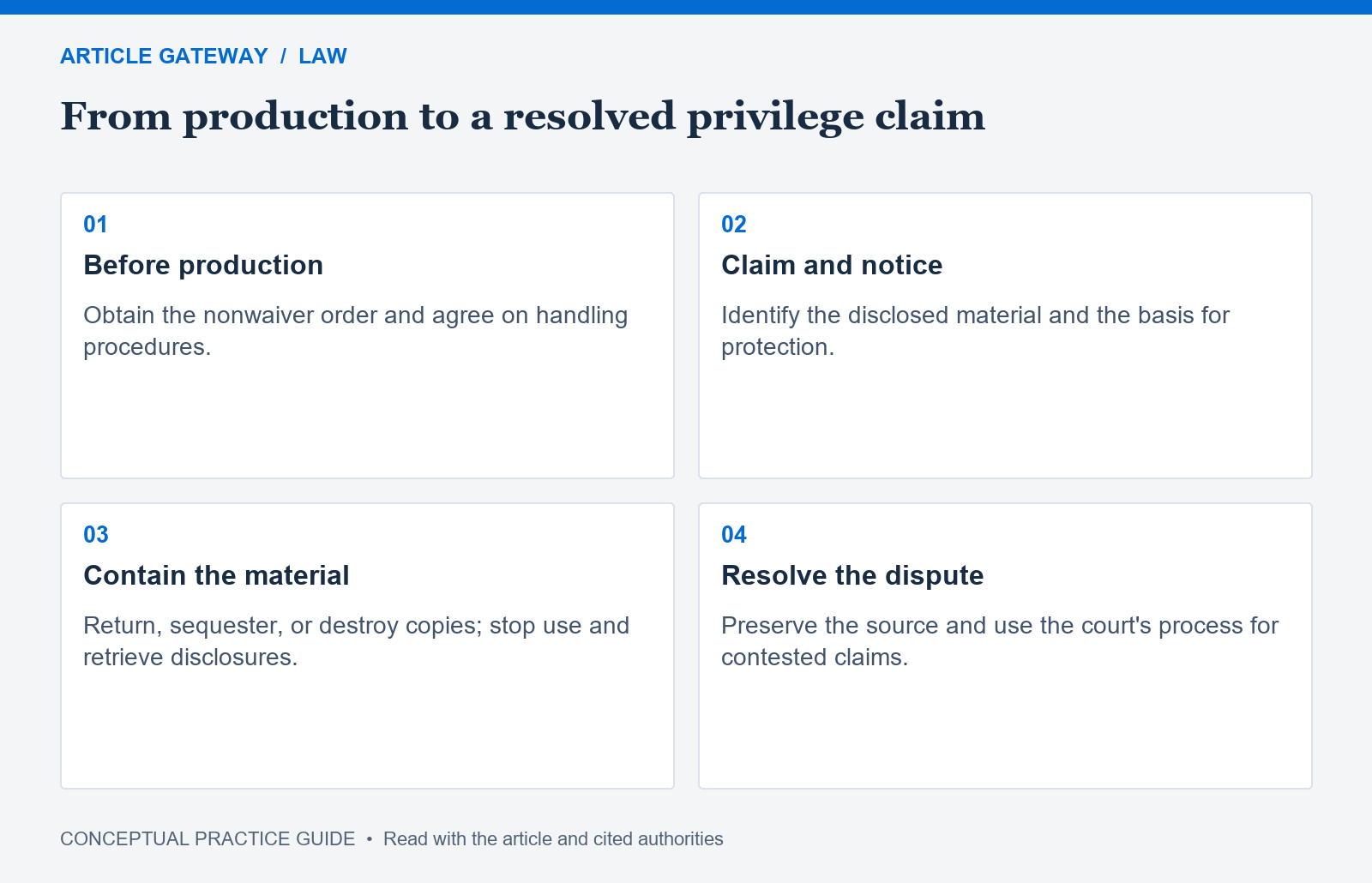
Understand the protection each mechanism provides
Federal Rule of Evidence 502(b) supplies a conditional protection for an inadvertent disclosure made in a federal proceeding or to a federal office or agency. The holder must have taken reasonable steps to prevent disclosure and promptly taken reasonable steps to rectify the error, including the applicable Civil Rule 26(b)(5)(B) procedure. Without an applicable broader order, those conditions can become the subject of expensive factual disputes.
Rule 502(d) authorizes a federal court to order that disclosure connected with the litigation before it does not waive attorney-client privilege or work-product protection. A covered disclosure then also does not constitute waiver in another federal or state proceeding. The order’s wording and scope matter: counsel should read the actual order rather than assume that every confidentiality provision provides equivalent protection.
A private agreement is different. Under Rule 502(e), an agreement about the effect of disclosure binds only its parties unless incorporated into a court order. The rule’s explanatory note explains why incorporation matters when parties seek protection against waiver arguments by nonparties.
Obtain the order before production
As a practical matter, seek a clear Rule 502(d) order early, alongside the discovery plan. Address the disclosures covered, whether protection depends on inadvertence or particular review precautions, and how notice and disputed claims will be handled. Avoid importing Rule 502(b)’s conditions unintentionally into an order intended to provide broader protection.
Judge Stewart D. Aaron’s published Southern District of New York template, for example, addresses production whether inadvertent or otherwise and preserves the parties’ ability to conduct preproduction review. It illustrates possible drafting, not a mandatory nationwide form or an order automatically applicable to another case.
A nonwaiver order does not make an unprivileged business communication privileged. Nor does it necessarily resolve waiver through an advice-of-counsel defense or other conduct outside the covered disclosure. Confidentiality, privilege, work product, and permission to seal a court filing remain separate issues. Review still serves purposes beyond avoiding waiver, including detecting irrelevant sensitive information and understanding the evidence.
Keep privilege descriptions on the agenda
Under Rule 26(b)(5)(A), a party withholding otherwise discoverable material must expressly assert the claim and describe the material sufficiently to permit assessment without revealing the protected information. An order addressing accidental production does not automatically dispense with that obligation.
The amendments effective December 1, 2025 make early planning particularly concrete: Rule 26(f)(3)(D) expressly includes the timing and method for complying with Rule 26(b)(5)(A), and Rule 16(b)(3)(B)(iv) permits the scheduling order to address them. Discuss workable descriptions, deadlines, and any proposed categorical treatment before the volume of documents creates a crisis. Check local rules and the assigned judge’s practices before selecting a format.
Execute the response when notice arrives
Rule 26(b)(5)(B) allows the producing party to notify recipients of the privilege or trial-preparation claim and its basis. Once notified, a recipient must promptly return, sequester, or destroy the specified information and copies; stop using or disclosing it until resolution; and take reasonable steps to retrieve information already disclosed. The recipient may promptly submit it under seal for a court determination. The producing party must preserve the information pending resolution.
Those handling duties operate while the merits remain disputed. Sequestering material is not an admission that the privilege claim is valid. As a practical protocol, identify the affected production numbers, restrict access in review platforms, inform relevant team members and experts, and track copies and derivative work that contain the material. Follow the governing order and local filing requirements when presenting the dispute.
Hypothetical: A defendant recalls an email chain after realizing that it contains counsel’s legal advice. The plaintiff believes the chain also contains ordinary business discussion. The plaintiff should isolate the identified material and stop using it while pursuing the prescribed challenge. It should not quote the disputed advice in a public filing as a way to force a ruling. The defendant should explain the protection claimed and preserve the chain.
Resolve the claim under the governing privilege law
Rule 502 governs specified waiver consequences, not every element of the underlying protection. Rule 501 directs the privilege inquiry, including state law for a civil claim or defense for which state law supplies the rule of decision. Mixed claims and particular privilege doctrines may require circuit-specific analysis.
The useful operational sequence is to secure an appropriate order, agree on descriptions and response procedures, implement access controls, and resolve contested claims through the court’s process. A short nonwaiver clause becomes more valuable when everyone handling discovery understands what to do the day a disclosure is discovered.
Scope: U.S. federal litigation, reviewed October 8, 2026. State-court procedures and underlying privilege law can differ; evaluate the particular order and governing law.