
A practical framework for litigation holds, lost messages, restoration efforts, and the separate findings required for curative measures and severe sanctions.
A company preserves employees’ email but lets its team-chat platform delete messages after thirty days. Months later, those messages become central to a contract dispute. The preservation question is larger than whether counsel sent a litigation hold: what information should have been retained, what steps were reasonable, and whether the missing material can still be recovered.
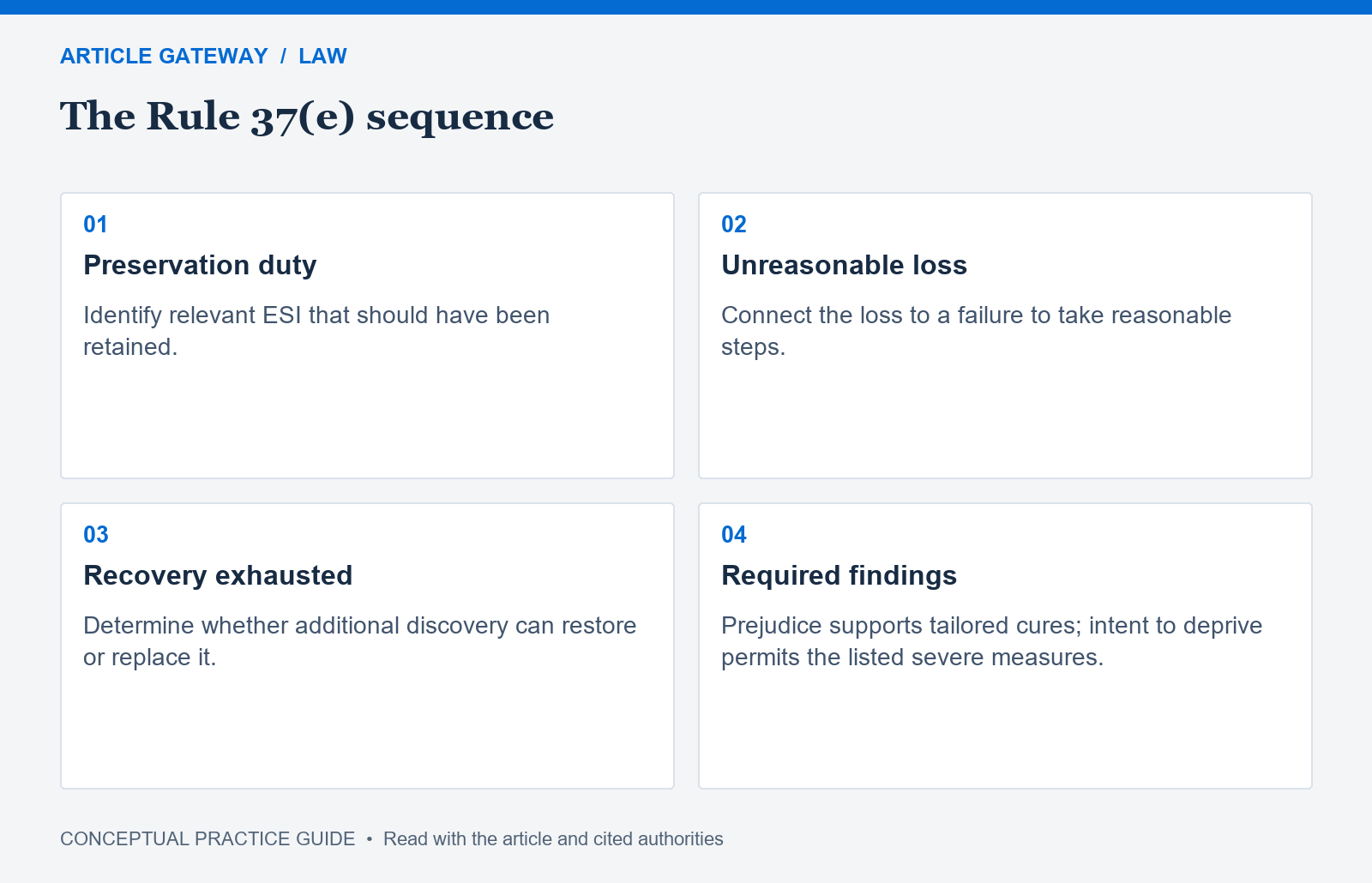
In federal civil litigation, Rule 37(e) supplies a structured analysis for lost electronically stored information, or ESI. Following that structure helps counsel design preservation measures and respond proportionately when something goes wrong.
Start with the rule’s threshold requirements
Rule 37(e) applies when ESI that should have been preserved in anticipation or conduct of litigation is lost because a party failed to take reasonable preservation steps, and the information cannot be restored or replaced through additional discovery. Each condition matters. A preservation mistake does not, by itself, establish entitlement to an adverse inference.
The 2015 advisory committee note explains that the rule draws on the existing common-law preservation duty rather than creating a new one. Reasonably foreseeable litigation can trigger that duty before a complaint arrives. The trigger and scope depend on what the party knew at the time; hindsight should not silently expand the original obligation.
That makes a contemporaneous record valuable. As a practical measure, record the events prompting preservation, potentially relevant claims, likely custodians, data sources, and reasons for the chosen scope. Revisit those judgments when the dispute changes. Apply controlling circuit precedent when deciding when the duty arose and what information it reached.
Translate a hold into actual retention
Reasonable steps require attention to how information is created and deleted. The committee note recognizes proportionality, resources, and the party’s sophistication; the standard does not demand perfect preservation. But an email instruction may accomplish little if an administrator’s retention setting keeps deleting the relevant chat history.
A useful implementation plan identifies the people who can suspend deletion and verifies what their changes actually preserve. Counsel should consider work phones, personal devices used for business, shared drives, cloud documents, collaboration platforms, and departing employees’ accounts when those sources may contain relevant material. This is a case-specific investigation, not a requirement to collect every device or freeze every system.
Practical verification might include confirming retention dates with IT, checking a sample export, recording preservation failures, and reminding custodians when their responsibilities change. Distinguish retaining information from immediately collecting, reviewing, or producing it. Those stages can have different costs and needs.
Investigate recovery before arguing sanctions
Deletion from one location does not necessarily mean information is irretrievably lost. Copies may remain with message recipients, in an archive, on another device, or in a backup. The rule directs attention to whether additional discovery can restore or replace the information.
Counsel should preserve surviving sources and document a proportionate recovery inquiry. Ask whether a replacement supplies the substance and context needed for the dispute, including attachments or metadata that matter. A screenshot may reproduce words while omitting the chronology needed to evaluate them. Conversely, an intact recipient copy may eliminate the asserted loss.
Separate prejudice from intent to deprive
Once the threshold requirements are met, Rule 37(e)(1) permits measures no greater than necessary to cure prejudice caused by the loss. The committee note leaves courts discretion over how prejudice is assessed and how its proof is allocated.
Rule 37(e)(2) reserves presumptions that the information was unfavorable, corresponding adverse-inference jury instructions, dismissal, and default for a finding of intent to deprive another party of the information’s use in litigation. Negligence or gross negligence alone does not satisfy that requirement. A separate prejudice finding is not required under that subsection, and a finding of intent does not make the listed sanctions automatic.
Hypothetical: A sales manager leaves after a preservation duty arises, and the company mistakenly deletes the manager’s chat account. If a complete archive restores the relevant messages, Rule 37(e)’s irretrievable-loss condition is absent. If restoration fails and the loss impairs proof, curative measures may be available upon the required findings. An instruction that the messages were unfavorable requires the additional intent finding.
Use early conferences to narrow uncertainty
Rule 26(f) requires discussion of preservation issues, while Rule 16 allows scheduling orders to address ESI preservation. Local rules add operational detail. For example, the District of Oregon’s Local Rule 26 directs discussion of an ESI liaison, preservation steps, and proportionality. That is a district-specific requirement, not a nationwide checklist.
For a potential motion, organize the record around timing, lost information, failed preservation steps, attempted replacement, prejudice, and any evidence of intent. For prevention, assign each preservation action an owner and verify completion. Those concrete records make both the preservation effort and any later judicial review more reliable.
Scope: U.S. federal civil procedure, reviewed October 8, 2026. State preservation rules and remedies can differ. Rule 37(e) addresses ESI; physical evidence, other discovery misconduct, and any independent state-law spoliation claim require separate analysis.