
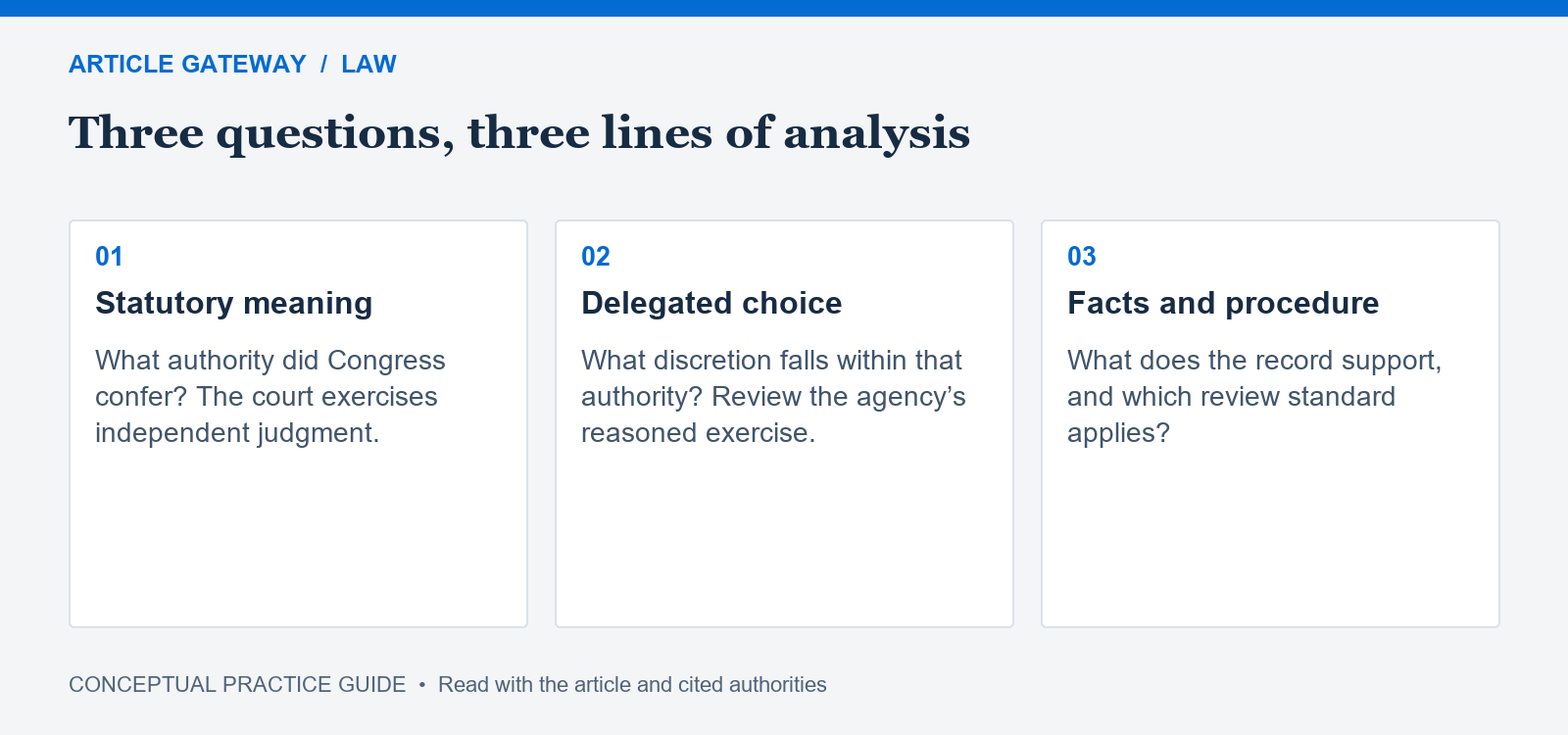
A useful federal agency challenge identifies which question belongs to the court, which choice Congress delegated, and which factual judgment the record must support.
For lawyers challenging or defending federal agency action, the central drafting task after Loper Bright Enterprises v. Raimondo is classification. A dispute over statutory authority, a dispute over scientific evidence, and a dispute over the exercise of delegated discretion require different arguments. Putting them all under the heading “no more deference” obscures the strongest issues and may invite the wrong standard of review.
Begin with the source of authority
In Loper Bright (2024), the Supreme Court overruled Chevron and required courts to exercise independent judgment on statutory meaning. Ambiguity alone no longer supplies a reason to accept an agency’s interpretation. The decision nevertheless recognizes that Congress can delegate discretion. Courts must identify that delegation, establish its boundaries, and review the agency’s exercise of authority within them. Agency reasoning can also persuade through expertise, consistency, and the quality of its analysis. Persuasive value is different from controlling interpretive authority.
A useful opening memorandum therefore starts with the enacted words. Identify the actor Congress empowered, the authorized action, the conditions attached to that power, and any exceptions. Then examine the surrounding provisions. A definition may narrow a broad operative clause; a specific remedial provision may illuminate what a general delegation permits. The objective is a defensible reading of the statute as a whole.
Match the objection to the review standard
Section 706 of the Administrative Procedure Act supplies several distinct grounds of review. It addresses action exceeding statutory authority, procedural defects, arbitrary or capricious decisionmaking, and, in specified proceedings, findings unsupported by substantial evidence. Its instruction to consider the record and prejudicial error also matters. Independent interpretation of a statute does not convert every factual dispute into a new evidentiary trial.
The practical implication is to write separate propositions. An authority argument should explain why Congress withheld or limited the asserted power. A record argument should identify the unsupported inference, omitted consideration, or unexplained choice. A procedural argument should identify the required step and why its omission matters. Alternative theories can reinforce each other, but each needs its own legal foundation.
Seven County Infrastructure Coalition v. Eagle County (2025) illustrates the distinction in the National Environmental Policy Act context. The Court contrasted interpreting a statutory requirement for a detailed environmental impact statement with deciding which factual details a particular statement should contain. The latter can involve substantial agency discretion. That decision concerns NEPA; its specific conclusions should not be transplanted mechanically into unrelated statutory schemes. Its methodological lesson is useful: identify the precise legal question before calling an agency determination a question of law.
Keep neighboring doctrines separate
Interpretation of an agency’s own regulation presents a different issue. Kisor v. Wilkie (2019) set demanding conditions for deference in that setting, including genuine ambiguity after ordinary interpretive tools are exhausted and an interpretation meeting requirements of reasonableness, authority, expertise, and fair judgment. Counsel should identify whether the contested language comes from Congress or the agency before choosing an interpretive framework.
Precedent requires equally careful treatment. Loper Bright expressly preserved ordinary statutory stare decisis for earlier holdings that particular agency actions were lawful. A prior decision’s use of Chevron is not, by itself, a sufficient reason to discard its holding. Compare the earlier judgment, statutory provision, and agency action with the present dispute rather than treating a methodological change as a universal reopening device.
A hypothetical classification exercise
Hypothetical: Congress authorizes an agency to require “reasonable safety inspections” of specified facilities. The agency imposes inspections on a different category of business and selects an unusually frequent schedule. Whether that business falls within the statute may be a question of statutory coverage. Whether the inspection frequency is adequately justified may depend on delegated discretion and the administrative record. Counsel should avoid assuming that success on one question resolves the other.
A working issue chart could place the statutory phrase, proposed interpretation, supporting authority, relevant record pages, and requested remedy in separate columns. This makes hidden gaps visible: an excellent textual argument may lack a reviewable action, while a strong technical criticism may seek a remedy disconnected from the alleged defect.
For an existing matter, review the administrative submissions before finalizing the complaint or petition. Confirm which objections were presented, what evidence entered the record, and which forum-specific preservation rules apply. Develop the requested judicial disposition alongside the merits argument; an instruction to reconsider a factual analysis and a ruling that an agency lacks statutory authority can have very different practical consequences.
Jurisdiction note: This analysis concerns federal agencies and the federal APA. State administrative procedure statutes, state constitutional structures, and state deference doctrines require separate research. Federal circuit precedent also matters when applying these principles to a particular regulatory program.